
About iStudy

Getvarsity is established and incorporated with the objective to provide a comprehensive range of Continuous Professional Development (CPD), Personnel Skill Assessment, Industrial Quality standardization, Corporate Training, and Personnel Skill Certification solutions that meet the needs of stakeholders in an ever-changing Industrial ecosystem.

Account

Follow Us

Food Safety Level 4 Certification

The Getvarsity Food Safety Level 4 Certification Course is an advanced, internationally recognized training program that strictly adheres to Codex Alimentarius Commission (CAC) guidelines and global industry standards, including ISO 22000 and GFSI. Designed for managers and industry leaders, this program fulfills the mandated IIRDC Specific module learning hours required for TÜV SÜD’s Certification of Persons (Food Safety Professional) & Furthermore, your training directly counts toward the IIRDC National Credit Framework (NCRF) Level 6 certification in Food Safety and Quality Management Skills if enrolled. Rated as the No. 1 highest-valued, globally recognized Food Safety Level 4 training.


Course Highlights

    • Food Safety Level 4 for Manufacturing Certification & Food Safety Level 4 for Catering Certification
    • Comprehensive Curriculum which Meets FSSAI (India), FSMA (USA), EU Food Law, GFSI, and ISO 22000 standards
    • Purpose : The primary purpose of the Level 4 Award in Food Safety Management is to equip senior supervisors, production managers, and quality assurance professionals with advanced expertise in developing, implementing, and monitoring robust food safety procedures. Designed to meet the highest industry standards, this advanced certification ensures that leaders have the strategic knowledge required to uphold impeccable hygiene practices, prevent contamination, and protect both consumers and brand reputation.
    • Scope : This comprehensive advanced food hygiene training covers a broad spectrum of the global and domestic food industry, including manufacturing, catering, hospitality, and retail. The scope of the course extends across the entire food supply chain, addressing complex safety parameters from raw material procurement and processing to packaging, storage, and final consumer delivery.
    • Benefits of Qualification : Achieving this top-tier Level 4 Food Safety qualification from a recognized leader like Getvarsity significantly accelerates your career progression in quality management. Graduates gain the credentials and authority to lead internal and external food safety audits, design bespoke HACCP plans, and confidently manage regulatory inspections. Furthermore, it empowers professionals to cultivate a proactive culture of food safety within their organizations, minimizing the risk of product recalls and legal liabilities.
    • Responsibilities of Certified Personnel : Professionals who complete this food safety manager certification are entrusted with pivotal organizational roles. Key responsibilities include designing, validating, and verifying comprehensive Food Safety Management Systems (FSMS). Certified personnel are also expected to conduct rigorous internal audits, ensure strict adherence to current national and international food safety legislation, and confidently deliver foundational hygiene training to subordinate staff to maintain operational excellence.
    • Eligibility Criteria : To ensure participants can fully engage with the advanced concepts covered, candidates applying for this Level 4 food safety management course should ideally hold a recognized Level 3 Food Safety certificate or Life science degree background, their is no strict eligibility criteria’s . Alternatively, applicants possessing substantial supervisory or managerial experience within the food manufacturing or catering sectors, alongside a strong practical foundation in basic food hygiene principles, are highly encouraged to apply.
    • Assessment Procedure : The certification process involves a rigorous, industry-aligned evaluation designed to test both theoretical knowledge and practical application. Candidates are typically assessed through a comprehensive written examination under controlled conditions, combined with an in-depth, workplace-scenario assignment. This ensures graduates can actively apply HACCP principles and effectively mitigate real-world food safety hazards.
    • Curriculum : The Level 4 Food Safety in Manufacturing and Catering syllabus is an advanced, management-level curriculum designed to equip food business operators and leaders with the expertise required to oversee and enforce strict food hygiene standards. The comprehensive program covers ten critical modules, beginning with an Introduction to Advanced Food Safety that focuses on managing foodborne illnesses and identifying contamination risks in high-risk foods. It dives deeply into Food Safety Legislation and Compliance, ensuring professionals understand global and national laws, including FSSAI, FDA, EFSA, and Codex Alimentarius. Core operational training includes Microbiology and Contamination Control, advanced implementation of HACCP (Hazard Analysis and Critical Control Points), and the auditing of Food Safety Management Systems (FSMS) such as ISO 22000, BRC, and GMP. Beyond the production floor, the syllabus ensures holistic safety through modules on Hygiene Management, strict Allergen Management and Food Labeling, and maintaining integrity across the Supply Chain and Distribution (including cold chain logistics and traceability). Finally, the curriculum prepares leaders for high-stakes scenarios with comprehensive training in Crisis Management and Emergency Response, culminating in strategies to build a resilient, ethical Leadership and Food Safety Culture dedicated to continuous improvement.
    • IIRDC High Value Personnel Skill ⁠⁠Certification Issued by Section - 8 Entity
    • Highly valued in the International job market with 150 + Countries Apostel Attestation Eligibility.
    • QR Scanning Verification to the Gov of India portal facility Available Upon Apostel Attestation.
    • Recognized in India, UAE, UK, USA, Canada, Australia, Middle East and European markets
    • IIRDC is recognised through various international ISO Standard certifications by organizations who are responsible for assessing the competence and capability of organisations.

Placements & Internships

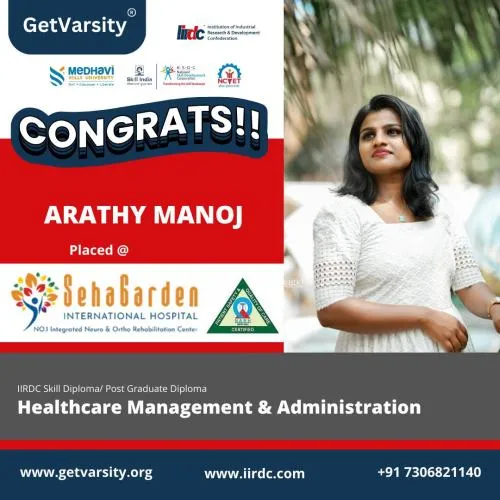
Sandra S
Arathy Manoj
Bineesh
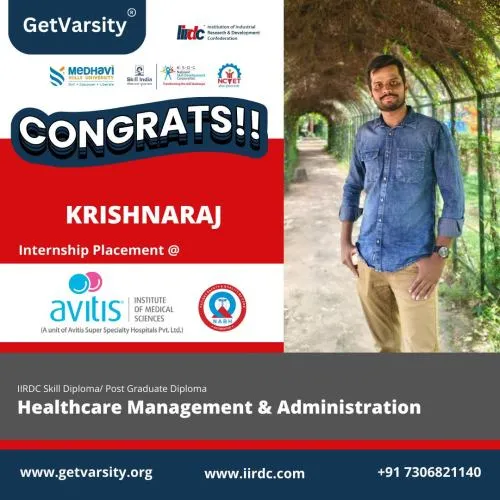
Krishna Raj
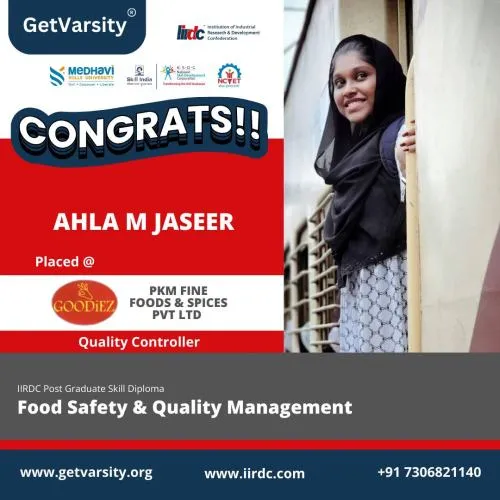
Ahla M Jaseer
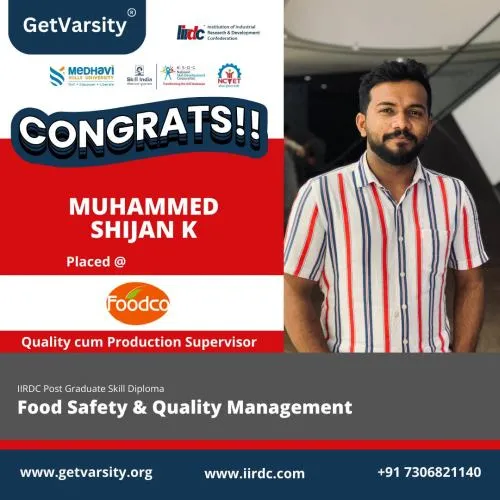
Muhammed Shijan K
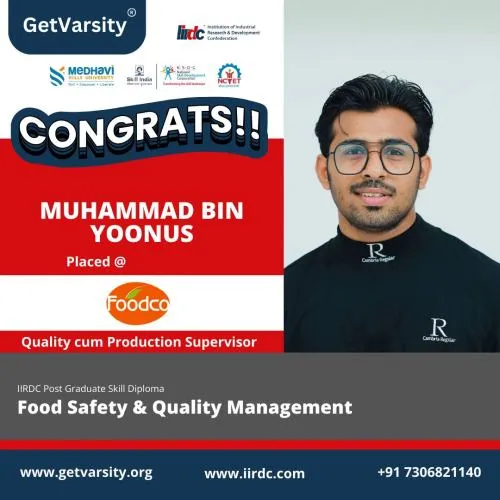
muhammed Bin Yoonus
Anaga
Anagha D
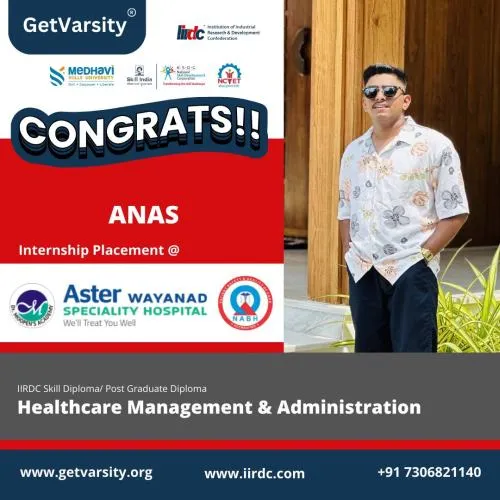
Anas

why getvarsity ?

skill india
Skill India Training Partner / Provider /
Project Management Unit (PMU)

IIRDC is an Skill India (Ministry of Skill Development &Entrepreneurship) TP which have rights to Approve, Accredit andCreate Training Centers (TC) under IIRDC and Impart NSQF, NHEQF,Non - NSQF Certification Programs. (Service Agreement Sl. No. B386880). All IIRDC TC’s would qualify as Government recognizedskill training institution status.

ncvet
NCVET Training Body

IIRDC is a Training Body having rights to Approve, Accredit and Create Training Centers under IIRDC TB of NCVET Awarding Body. Also IIRDC holds Rights of Research & Development of New Industry Anchored NSQFand NHEQF Qualifications Through AB. All confederation companiesunder IIRDC will be accredited skill centers of AB.

ugc
UGC Approved Skill University's Industry Outreach
Partner / Skill Training Partner & Service Partner

GetVarsity is a company, not a UGC-regulated HEI, and provides fee-based Skill training and institutional support, while universities handle all academic processes, including admissions, exams, and awarding degrees. GetVarsity partners with universities and industry to integrate higher education with skill development, supporting UGC-approved work-integrated, vocational, and apprenticeship-based programs aligned with NEP 2020. 

iirdc
Personnel Skill Assessment & Certification Body

IIRDC Is an Autonomus Skill Assessment and CertificationAwarding Bodyworking as per the norms under international standards forGeneralrequirements for bodies operating certification of persons.IIRDCensures that a certified candidate holds the skills andexpertise ina specialized area through systematic assessments.

TÜV SÜD
TUV SUD Germany Food Safety and Quality 1st Cooperation Partner in India

TÜV SÜD Germany is a globally trusted technical service providerwithover 150 years of legacy in quality assurance and safety.Renowned forits rigorous standards, TÜV SÜD offers comprehensive testing,inspection, auditing, and certification services tailored to the food industry. Getvarsity is an official Training center & Confederation company of IIRDC ( TÜV SÜD Cooperation Partner )

digilocker
DigiLocker Verified

All IIRDC NCrF (NHEQF / NSQF) Aligned Skill Qualification Certifications issued in association with NCVET AB will be added into DigiLocker — a platform where Government Documents like Aadhaar, PAN, and Driving License are issued and verified. Credits will also be issued in ABC verifiable through DigiLocker.

abc skill credits
Academic Bank of Credits (ABC) Body

ABC is a digital system established under the National Education Policy (NEP) to facilitate credit accumulation, transfer, and redemption across higher education institutions. It allows candidates to earn credits for completed coursework. As per the ABC framework, 30 hours of learning equate to 1 academic credit, ensuring standardized recognition of learning outcomes across institutions. All NCrF aligned courses provided by Getvarsity holds ABC Skill credits.

nad
National Academic Depository (NAD)

NAD is a platform established by the Government to securely store and verify academic awards issued. Managed by DigiLocker and integrated with the Academic Bank of Credits (ABC), it enables verified documents anytime, reducing fraud and administrative delays while supporting the goals of NEP 2020. Certificates issued for Getvarsity students, which are aligned to NCrF, is linked to NAD.

nep 2020
National Education Policy (NEP)

The National Education Policy (NEP) 2020 aims to create a flexible and integrated education system. It connects school, higher, and vocational learning through the National Credit Framework (NCrF), National Higher Education Qualification Framework (NHEQF), and National Skills Qualifications Framework (NSQF), enabling credit transfer, skill integration, and lifelong learning. Getvarsity delivers NCrF courses aligned to NEP 2020 

Frequently Asked Questions

What Makes Food Safety Level 4 Training & Certification by the GetVarsity Best and No.1?
The Food Safety Level 4 Training & Certification Course is the gold standard in food safety education, designed for food business owners, managers, supervisors, and professionals who need advanced expertise in food safety compliance. If you are looking for the best and most recognized training program, GetVarsity offers a globally accredited, industry-approved, and career-boosting certification that ensures you stay ahead in the food industry.

At GetVarsity, we provide FSSAI, HACCP, and ISO-compliant training, ensuring that our certification meets international food safety standards. Whether you are in India or Kerala, this course is recognized by food safety authorities worldwide, making it the No.1 choice for those aiming to work in food production, catering, hospitality, and retail food businesses. With our comprehensive curriculum, participants gain in-depth knowledge of food hygiene, risk management, HACCP implementation, foodborne illness prevention, and legal compliance—all essential for running a safe and compliant food business.

What sets GetVarsity’s Food Safety Level 4 Course apart is its flexibility and expert-led training. We offer both online and classroom learning options, allowing you to complete your certification at your own pace. Whether you prefer self-paced learning or interactive instructor-led sessions, our platform ensures that you receive top-quality training with real-world case studies and practical applications. Upon completion, you will receive an instant digital certification, which is widely accepted for job applications, business audits, and government regulations.
Beyond compliance, this certification plays a significant role in career growth and business success. Food safety managers and supervisors who complete GetVarsity’s Level 4 certification are in high demand across the food industry. This qualification enhances job prospects, increases salary potential, and builds trust among customers, regulatory bodies, and food safety auditors. Many top employers prefer candidates with a Level 4 certification, making it an essential qualification for those looking to advance in the food industry.

With GetVarsity’s globally recognized training, expert instructors, and career-enhancing benefits, the Food Safety Level 4 Training & Certification is the best, most valuable, and No.1 choice for professionals who want to excel in food safety. Don’t wait—enroll today with GetVarsity and take the next step in your food safety career! 

What is the Course Duration of the Food Safety Level 4 Certification Course?
The Food Safety Level 4 Certification Course offered by GetVarsity is a comprehensive training program designed for food safety managers, supervisors, and industry professionals. This advanced certification requires 24 to 40 guided learning hours, covering critical topics such as food hygiene regulations, HACCP principles, risk management, and legal compliance. Unlike many other training providers, GetVarsity ensures industry-leading education with globally recognized certification, fully compliant with FSSAI, HACCP, and ISO food safety standards. Our course enhances career prospects, regulatory compliance, and business credibility in food production, catering, hospitality, and retail industries. By choosing GetVarsity, you gain access to expert trainers, high-quality study materials, real-world case studies, and a certification that employers trust.

For Detailed Syllabus Call or Whatsapp On: +91 7306136806
Food Safety Level 4 Syllabus Topics – What Will You Study?
Key Topics Covered in the Food Safety Level 4 Course
 
Food Safety Legislation and Compliance
National and international food safety laws
Regulatory requirements (FSSAI, HACCP, ISO 22000)
Roles and responsibilities of food safety managers
Hazard Analysis and Critical Control Points (HACCP)
HACCP principles and implementation
Identifying critical control points (CCPs)
Risk assessment and preventive measures
Foodborne Illnesses and Contamination Control
Microbiological, chemical, and physical hazards
Pathogens, cross-contamination, and food poisoning prevention
Best practices for food hygiene and sanitation
Food Safety Management Systems (FSMS)
Developing and implementing FSMS
Risk management and corrective actions
Continuous monitoring and auditing procedures
Allergen Management and Food Labeling
Identifying and managing food allergens
Food labeling requirements and legal compliance
Allergen-free food preparation and best practices
Personal Hygiene and Workplace Safety
Hygiene standards for food handlers
Cleaning, disinfection, and pest control
Safe food storage, handling, and transportation
Crisis Management and Emergency Planning
Managing food recalls and safety incidents
Legal responsibilities during a crisis
Effective communication strategies for food safety management

Who Should Attend the Food Safety Level 4 Training and Certification?
The Food Safety Level 4 Training and Certification is an advanced course designed for individuals who play a critical role in maintaining high food safety standards in the food industry. This course is ideal for professionals responsible for food hygiene, safety management, and regulatory compliance at an advanced level.

Who Should Enroll in This Course?

  • Food Safety Managers & Supervisors
    • Those responsible for implementing and managing food safety systems
    • Professionals overseeing HACCP, ISO 22000, and FSSAI compliance
  • Quality Assurance & Control Professionals
    • Individuals managing food quality standards and safety audits
    • Those ensuring compliance with national and international food regulations
  • Restaurant Owners & Food Business Operators
    • Entrepreneurs and managers in the hospitality, catering, and restaurant industry
    • Professionals looking to enhance food hygiene and customer safety
  • Catering & Hospitality Professionals
    • Executive chefs, kitchen managers, and head cooks
    • Professionals responsible for safe food handling and kitchen hygiene
  • Manufacturers & Food Processing Industry Leaders
    • Factory managers and production supervisors in the food processing sector
    • Those responsible for food handling, storage, and risk management
  • Food Inspectors & Regulatory Officers
    • Government and private sector food safety inspectors
    • Professionals involved in health and safety compliance checks
  • Trainers & Consultants in Food Safety
    • Individuals conducting food safety training and audits
    • HACCP and ISO food safety consultants

Career Opportunities After Food Safety Level 4 Certification
Earning a Food Safety Level 4 Certification from GetVarsity opens doors to high-paying and leadership roles in the food industry, hospitality, and regulatory sectors. This advanced qualification is recognized globally and helps professionals secure top-tier positions in food safety management, quality assurance, and compliance roles.

Top Career Opportunities After Completing Food Safety Level 4

  • Food Safety Manager / Supervisor
    • Oversee food safety policies, hygiene practices, and compliance
    • Manage HACCP, ISO 22000, and FSSAI food safety systems
    • Ensure safe food handling and regulatory adherence in businesses
  • Quality Assurance (QA) & Quality Control (QC) Officer
    • Monitor food production quality standards and safety audits
    • Implement risk assessments, contamination controls, and hygiene protocols
    • Ensure compliance with national and international food laws
  • HACCP & Food Safety Consultant
    • Provide food businesses with expert guidance on safety regulations
    • Develop and implement HACCP and food safety management systems
    • Conduct audits and staff training for food safety compliance
  • Food Safety Auditor / Regulatory Officer
    • Work with government agencies or private organizations
    • Inspect food facilities to ensure legal compliance and hygiene standards
    • Conduct investigations and report on food safety violations
  • Catering & Hospitality Industry Professionals
    • Suitable for executive chefs, restaurant managers, and catering heads
    • Ensure kitchen safety, hygiene, and food quality management
    • Implement FSSAI and HACCP standards in food service operations
  • Food Production & Manufacturing Supervisor
    • Manage food processing, packaging, and distribution safety
    • Ensure food products meet global safety and hygiene standards
    • Work in food factories, processing plants, and manufacturing units
  • Food Safety Trainer & Educator
    • Train food handlers, chefs, and industry professionals
    • Conduct workshops on hygiene, HACCP principles, and risk management
    • Work with colleges, training institutes, and corporate food businesses

  • Awarded as IIRDC's Best Center For Skill Excellence in India. 
  • NCVET Awarding Bodies empaneled Skill India (Skill India - Ministry of Skill Development and Entrepreneurship) Approved Training Center (TC) Under IIRDC Training body (TB &TP).
  • Industry Outreach Partner, Service Partner, &Vocational Training partner of multiple UGC, NSDC and NCVET recognized Skill Universities.
  • Special Right to develop and implement NHEQF, NSQF programs with Digi locker ABC credits through IIRDC.
  • Accredited by ISO and International bodies of UK, USA, UAE, Egypt, European countries, Etc.
  • Gov Skill Loan, Educational & IIRDC GST Exemptions.

What Does a Food Safety Level 4 Professional Do?
A Food Safety Level 4 professional plays a crucial role in ensuring high standards of food safety, hygiene, and regulatory compliance in the food industry. This advanced qualification equips professionals with expert-level knowledge to manage food safety risks, implement HACCP and ISO 22000 standards, and oversee compliance with national and international food safety laws.

Key Responsibilities of a Food Safety Level 4 Professional

  • Food Safety Management & Compliance
    • Develop and implement food safety management systems (FSMS)
    • Ensure compliance with HACCP, FSSAI, ISO 22000, and other food safety regulations
    • Conduct risk assessments and establish critical control points (CCPs)
  • Supervising Food Handling & Hygiene Practices
    • Monitor hygiene standards in food production, catering, and retail environments
    • Train staff on proper food handling, allergen management, and contamination control
    • Implement best practices for cleaning, sanitation, and pest control
  • Conducting Audits & Inspections
    • Perform internal audits and hygiene inspections to maintain food safety standards
    • Identify hazards and implement corrective and preventive actions
    • Work with government bodies and certification agencies to ensure compliance
  • Training & Educating Food Handlers
    • Develop and conduct food safety training programs for employees
    • Create awareness about foodborne illnesses, microbiological hazards, and personal hygiene
    • Ensure businesses follow legal food safety requirements to prevent health risks
  • Crisis Management & Food Safety Incident Handling
    • Investigate food safety breaches, recalls, and contamination cases
    • Implement emergency response plans to handle food safety crises
    • Maintain proper documentation and reporting for audits and legal compliance
  • Quality Assurance & Control in Food Production
    • Oversee food production processes to ensure safe food storage, processing, and packaging
    • Maintain high standards of food quality, shelf-life monitoring, and labeling compliance
    • Work with suppliers and manufacturers to reduce risks of contamination

Salary After Food Safety Level 4 Certification
Earning a Food Safety Level 4 Certification significantly enhances career prospects and salary potential in the food industry, hospitality, manufacturing, and regulatory sectors. Professionals with this certification are in high demand for their expertise in food safety management, HACCP compliance, and quality assurance. Salaries vary based on factors such as experience, industry, job role, and location. In India, certified professionals can earn between INR 5,00,000 to INR 15,00,000 per year, depending on their role, while internationally, salaries range from USD 45,000 to USD 100,000 per year. Positions such as Food Safety Manager, Quality Assurance Officer, HACCP Consultant, and Regulatory Auditor offer lucrative career opportunities with potential salary growth. With organizations prioritizing food safety and regulatory compliance, the demand for skilled professionals continues to rise, making this certification a valuable investment for career advancement. At GetVarsity, we provide globally recognized training that equips professionals with industry-leading knowledge and practical skills to excel in food safety management. Our certification meets HACCP, ISO 22000, and FSSAI standards, ensuring that graduates are well-prepared for high-paying job opportunities. By obtaining the Food Safety Level 4 Certification from GetVarsity, professionals can unlock top-tier job roles, competitive salaries, and leadership positions in the food industry. Enroll today with GetVarsity and take a step toward a high-paying career in food safety!

Why Is Food Safety Level 4 Certification Essential for a Global Food Safety Career?
A Food Safety Level 4 Certification is a crucial qualification for professionals aiming to establish a successful global food safety career. In today’s highly regulated food industry, businesses must comply with international food safety standards such as HACCP, ISO 22000, FSSAI, FDA, and Codex Alimentarius. This advanced certification equips professionals with expert-level knowledge in food safety management, risk assessment, regulatory compliance, and hygiene practices, making them highly sought after by food manufacturers, hospitality industries, regulatory bodies, and global food supply chains.

With increasing concerns over foodborne illnesses, contamination risks, and strict global regulations, companies require certified professionals who can ensure food safety, conduct audits, implement HACCP protocols, and train food handlers. A Food Safety Level 4 certification opens up career opportunities in food production, quality assurance, auditing, catering, food import-export, and consultancy roles worldwide. Certified professionals are also eligible for high-paying leadership positions such as Food Safety Manager, HACCP Consultant, Quality Assurance Officer, and Regulatory Compliance Auditor.

At GetVarsity, we offer globally recognized Food Safety Level 4 training, designed to provide in-depth industry knowledge and practical skills that align with international food safety standards. Our certification ensures that professionals are well-equipped to work in multinational food corporations, global restaurant chains, and regulatory agencies, helping them secure top-tier jobs and advance in their careers. If you’re looking to build a successful global food safety career, enroll with GetVarsity today and gain a competitive edge in the industry!

The Level 4 Food Safety qualification, often referred to as an Advanced Food Hygiene certificate, is the highest level of food safety training available. It is specifically designed for managers, business owners, and senior hygiene personnel. The course covers advanced principles of food safety management, microbiology, comprehensive HACCP (Hazard Analysis and Critical Control Point) systems, and strict legal compliance to ensure a rigorously safe food handling environment.

A Level 4 Food Hygiene certificate is essential for anyone in a senior management, directorial, or strategic role within the food catering, manufacturing, or retail sectors. This includes Head Chefs, Executive Chefs, Production Managers, Quality Assurance (QA) Managers, and Food Business Operators who are directly responsible for designing, implementing, and monitoring Food Safety Management Systems (FSMS) and training staff.

The Level 4 syllabus is highly rigorous. Key topics covered include advanced bacteriology and the prevention of foodborne illnesses, physical and chemical contamination controls, designing and auditing advanced HACCP systems, comprehensive UK and international food safety legislation, personal hygiene policies, pest control management, cleaning and disinfection protocols, and strategies for delivering effective food safety training to staff.

Typically, a comprehensive Level 4 Managing Food Safety course requires approximately 40 hours of guided learning. In a traditional classroom setting, this is delivered over 4 to 5 days. For online or blended learning formats, students can complete the modules at their own pace, dedicating equivalent hours to master the advanced food hygiene syllabus and properly prepare for the final examination.

Legally, food safety certificates do not have a strict expiration date. However, industry best practices, auditing bodies, and Environmental Health Officers (EHOs) strongly recommend undertaking a refresher course every 3 years. This ensures that management teams stay entirely up to date with the latest changes in food safety regulations, HACCP updates, and industry standards.

Yes! The core principles taught in the Level 4 Food Safety course are universally applicable across all major food sectors. Whether you are managing a large-scale catering operation, overseeing a high-volume food manufacturing plant, or directing a multi-site retail food business, this advanced food hygiene training provides the critical operational skills needed to maintain strict legal compliance and safety standards.

Absolutely. Having a manager or business owner certified at Level 4 demonstrates a profound commitment to food safety to local authorities and EHOs. The advanced knowledge gained in this course allows you to implement robust, fail-safe hygiene practices and documentation, which are key requirements for achieving and maintaining a maximum 5-star Food Hygiene Rating.

The Food Safety Level 4 certification is the highest level of food safety qualification available to food industry professionals, designed for managers, supervisors, and business owners who carry strategic responsibility for food safety compliance within their organisation. It provides advanced, in-depth knowledge of food hygiene principles, Hazard Analysis and Critical Control Points (HACCP) implementation, food safety management systems (FSMS), risk assessment, foodborne illness prevention, and regulatory compliance across national and international standards including FSSAI, FSMA, EU Food Law, GFSI, and ISO 22000. Completing the Level 4 qualification demonstrates mastery-level competence that is recognised by employers, food safety auditors, and regulatory bodies worldwide.

The Food Safety Level 4 certification is designed for food industry professionals and fresher graduates who hold or are seeking management-level responsibility for food safety within their organisation. Ideal candidates include food business owners, catering and hospitality managers, food production supervisors, quality assurance managers, HACCP team leaders, food safety consultants, regulatory compliance officers, and senior kitchen staff including head chefs. It is also highly relevant for professionals who conduct or oversee food safety audits, develop food safety policies, or manage teams responsible for compliance with FSSAI, FSMA, EU Food Law, or other national food hygiene regulations.

Food Safety Level 3 equips supervisors and team leaders with the knowledge to monitor, implement, and manage food safety procedures and HACCP plans in their day-to-day work environment. Food Safety Level 4 is a more advanced qualification that builds on Level 3 by focusing on establishing, auditing, and critically evaluating entire food safety management systems (FSMS) across an organisation. Level 4 covers advanced risk assessment, FSMS design and implementation, internal auditing, legislative management, and leadership in food safety culture. While Level 3 is sufficient for supervisory roles, Level 4 is required for senior management positions and organisations operating under GFSI-recognised schemes such as FSSC 22000, BRC, or SQF.

Their is no strict eligibility criteria , even though  Candidates enrolling in the Food Safety Level 4 certification are ideally expected to hold an intermediate Level 3 food safety or food hygiene certificate, or to have equivalent practical experience working in a food safety supervisory or management role. A good level of English literacy and numeracy is recommended, as the qualification involves written assessments requiring analytical and evaluative responses. The course is designed for food industry professionals rather than complete beginners, so prior exposure to food safety legislation, hygiene procedures, or HACCP principles will significantly enhance your learning experience. Contact GetVarsity directly if you are unsure whether your background meets the entry requirements.

The Food Safety Level 4 curriculum covers advanced food hygiene principles, HACCP system development and critical evaluation, food safety management system (FSMS) design and implementation, risk assessment and hazard identification, foodborne illness and contamination prevention, prerequisite programmes (PRPs), legal and regulatory compliance (FSSAI, FSMA, EU Food Law, ISO 22000, GFSI), food safety auditing methodologies, corrective and preventive action (CAPA) systems, temperature control and cold chain management, food labelling and traceability, and leadership in food safety culture. The curriculum is structured to meet the demands of real-world food business operations across manufacturing, catering, retail, and hospitality sectors.

The Food Safety Level 4 certification typically requires between 24 and 40 guided learning hours to complete, depending on your prior food safety knowledge and the pace at which you study. In an instructor-led classroom format, the course is usually delivered over 3 to 5 days. In the online self-paced format offered by GetVarsity, learners can spread their study across several weeks to fit around their professional commitments. Upon successful completion of the assessment, a digital certificate is issued instantly, allowing you to begin using your qualification for job applications, business audits, and regulatory compliance purposes without delay.

Yes. GetVarsity's IIRDC Food Safety Level 4 certification carries accreditation recognised across international food industry markets.The qualification is accepted for food safety roles and compliance purposes in India, the UAE, UK, USA, Canada, Australia, the Middle East, and European markets. The curriculum aligns with globally recognised standards including FSSAI, FSMA, EU Food Law, GFSI, and ISO 22000, making the credential relevant across multiple regulatory environments worldwide.

Yes, GetVarsity offers the Food Safety Level 4 certification through flexible online and classroom learning formats. The online delivery combines self-paced video lessons, interactive modules, and digital assessments, allowing busy food industry professionals to complete the qualification without attending a physical training centre. This is particularly valuable for professionals in remote locations or those balancing full-time work with professional development. Upon successfully passing the assessment, you receive a certificate that is valid for job applications, client audits, and regulatory submissions. Both online and classroom completions carry equal accreditation status under the IIRDC Training Body framework.

A Food Safety Level 4 certificate significantly expands career opportunities and earning potential in the food industry. Certified professionals qualify for senior roles including Food Safety Manager, Quality Assurance Manager, Regulatory Compliance Officer, HACCP Consultant, Food Safety Auditor, and Technical Director across food manufacturing, catering, hospitality, retail, and government regulatory bodies. In India, Level 4 certified food safety professionals typically earn between INR 2,00,000 and INR 15,00,000 per year, depending on role and experience. Internationally, salaries for food safety management roles commonly range from USD 45,000 to USD 100,000 per year. Organisations operating under GFSI-recognised schemes frequently mandate Level 4 qualification for senior food safety appointments.

Food Safety Level 4 is a comprehensive advanced qualification covering the full spectrum of food safety management — including HACCP, food microbiology, food safety legislation, allergen management, contamination control, crisis management, and FSMS design. HACCP Level 4 focuses specifically on developing, implementing, and auditing HACCP plans based on the Codex Alimentarius 7 principles and 12-step methodology. In practice, Food Safety Level 4 includes HACCP as one of several core components but goes significantly beyond it by also covering prerequisite programmes (PRPs), regulatory compliance across FSSAI, FSMA, EU Food Law, and GFSI standards, and organisational food safety culture. Most employers and auditing bodies consider Food Safety Level 4 the more comprehensive qualification for senior management roles.

Food Safety Level 4 certification equips Indian food exporters with advanced knowledge of the exact regulatory frameworks required by international markets. For EU exports, the certification covers EU Regulation (EC) No 852/2004 on food hygiene, RASFF compliance, and MRL requirements. For USA exports, it aligns with FDA FSMA Preventive Controls and HARPC. For Gulf countries (UAE, Saudi Arabia, Qatar), it covers GSO food safety requirements and municipality-level compliance. Kerala's spice exporters, seafood processors, and packaged food manufacturers specifically benefit because Level 4 training teaches the HACCP documentation, traceability systems, and allergen management protocols that importing countries mandate before accepting shipments.

FSSAI FoSTaC is India's mandatory domestic certification for food safety supervisors, valid for 2 years, covering basic to advanced food safety awareness under FSSAI licensing regulations. Food Safety Level 4 is an internationally recognised advanced management qualification that goes far beyond FoSTaC in depth, covering HACCP system design, FSMS implementation, food safety auditing, crisis management, and compliance with global standards (ISO 22000, GFSI, FSMA, EU Food Law). FoSTaC is legally required for all food business operators in India, while Level 4 is for managers seeking leadership roles, international career opportunities, or export compliance. Ideally, food safety professionals should hold both: FoSTaC for Indian regulatory compliance and Level 4 for advanced career growth and global recognition.

The Food Safety Level 4 examination consists of 30 multiple-choice questions and 4 long-answer (structured/essay) questions, with a minimum pass mark of 60% required in each component separately. The MCQs test knowledge across all syllabus areas, while the long-answer questions require analytical and evaluative responses on HACCP implementation, FSMS design, risk assessment, and legislative compliance. You cannot compensate a weak score in one section with a strong score in the other. GetVarsity provides comprehensive exam preparation including practice questions, case studies, and mock assessments.

Highfield (HABC), RSPH, and CIEH are UK-based awarding bodies offering Level 4 food safety qualifications under the UK's RQF framework, designed primarily for the UK regulatory context. GetVarsity's IIRDC-accredited Food Safety Level 4 covers the same advanced competencies — HACCP, FSMS, food microbiology, risk assessment, and food legislation — but is specifically designed for international applicability, covering FSSAI (India), FSMA (USA), EU Food Law, GFSI standards, and ISO 22000 simultaneously. This multi-jurisdictional approach makes it more versatile for professionals working in India, the Gulf, Asia, and other non-UK markets. The IIRDC certification also carries apostille attestation eligibility for 150+ countries.

Food Safety Level 4 is not legally mandatory under FSSAI — the mandatory requirement is FoSTaC certification for Food Safety Supervisors. However, Level 4 is strongly recommended and increasingly expected because FSSAI's Schedule 4 requires HACCP-based food safety management systems, and Level 4 is the qualification that trains managers to design and manage these systems. Food businesses seeking GFSI-benchmarked certifications (FSSC 22000, BRCGS, SQF), export approvals, or multinational contracts typically require Level 4 certified food safety managers. For Kerala businesses dealing with exports, hotel chains, or institutional catering, Level 4 has effectively become a de facto industry standard.

Cloud kitchens face unique food safety challenges including high-volume multi-brand production, delivery time-temperature compliance, and cross-contamination risks from shared kitchen spaces. Level 4 trains operators in HACCP implementation for multi-product environments, cold chain management during last-mile delivery, allergen cross-contact prevention, and crisis management for food safety incidents. With India's online food delivery market projected to exceed $20 billion by 2027 and FSSAI tightening regulations on food aggregators (Swiggy, Zomato), cloud kitchen operators with Level 4 certification demonstrate regulatory compliance, reduce liability risks, and gain competitive advantage in platform listings and commercial partnerships.

Yes, Food Safety Level 4 is one of the most valuable certifications for hotel managers, F&B directors, and executive chefs in Kerala's tourism and hospitality industry. Kerala receives 20+ million tourists annually, and hotels must maintain rigorous food safety across restaurants, banquets, room service, and Ayurvedic food programmes. Level 4 trains hospitality professionals in managing food safety across multiple outlets, catering HACCP implementation, and allergen management for international guests. Major hotel chains (Taj, ITC, Marriott, Hyatt, CGH Earth) increasingly require F&B managers to hold advanced food safety qualifications. For Kerala's medical tourism and wellness resort sector, Level 4 is particularly valuable for therapeutic and Ayurvedic dining programme safety.

Prerequisite programmes (PRPs) are the foundational food safety conditions and activities that must be in place before implementing HACCP — they form the base of the food safety management pyramid. PRPs include Good Manufacturing Practices (GMP), Good Hygiene Practices (GHP), sanitation and cleaning schedules, pest control programmes, water quality management, supplier approval, equipment maintenance, waste management, personal hygiene policies, and staff training. Level 4 training covers PRP design, implementation, monitoring, and verification in detail because FSSAI, GFSI, and FDA evaluate PRPs as the first layer of compliance before reviewing HACCP plans. Without robust PRPs, a HACCP system cannot function effectively.
Food allergen management is a critical Level 4 module covering the 14 internationally recognised major food allergens: cereals containing gluten, crustaceans, eggs, fish, peanuts, soybeans, milk, tree nuts, celery, mustard, sesame seeds, sulphites, lupin, and molluscs. The training teaches managers how to implement allergen control plans, prevent cross-contact during preparation and manufacturing, design allergen-safe workflows, ensure accurate food labelling per FSSAI and international regulations, train staff in allergen awareness, and manage allergen-related emergencies including anaphylaxis response. With food allergy prevalence rising globally, allergen management expertise is a major differentiator for food safety professionals.

Food safety culture refers to the shared values, beliefs, attitudes, and behaviours toward food safety within an organisation — it determines how seriously everyone from the CEO to the food handler takes food safety. The Codex Alimentarius, GFSI, and BRCGS Issue 9 now explicitly require food businesses to demonstrate a positive food safety culture. Level 4 training emphasises leadership because research shows management commitment is the single strongest predictor of food safety compliance. The course teaches how to assess food safety culture maturity, develop improvement strategies, implement feedback mechanisms, secure management commitment, and measure culture through KPIs and staff surveys.

Yes, Food Safety Level 4 is the essential foundation qualification for a career in food safety auditing. The certification trains you in auditing methodologies, HACCP verification, CAPA systems, and compliance evaluation against FSSAI, ISO 22000, and GFSI standards. After Level 4 and 2–3 years of experience, you can pursue Lead Auditor certifications from IRCA, Exemplar Global, or scheme-specific qualifications for BRCGS, FSSC 22000, SQF, or IFS. Food safety auditors earn INR 12–25 LPA in India and USD 60,000–120,000 internationally. Third-party firms actively recruit Level 4 certified professionals.

GFSI (Global Food Safety Initiative) is a private-sector coalition that benchmarks food safety standards worldwide, including BRCGS, FSSC 22000, SQF, IFS, and Global GAP. These schemes are required by major global retailers (Walmart, Tesco, Carrefour, Amazon Fresh, Costco) as a condition for doing business. GFSI schemes mandate trained food safety management personnel with Level 4 competencies — HACCP system design, FSMS auditing, risk assessment, and corrective action management. For Indian food companies seeking BRCGS or FSSC 22000 certification for export markets, having Level 4 certified managers is often a pre-audit requirement that certification bodies verify before granting accreditation.

The temperature danger zone (5°C to 63°C) is where pathogenic bacteria multiply rapidly, and Level 4 provides advanced management-level understanding of temperature control systems. The course covers cold chain integrity from receipt to dispatch, chilling requirements (below 8°C within 90 minutes), freezing and blast chilling standards, hot holding (above 63°C), cooking core temperatures for different food categories (poultry 75°C, minced meat 70°C), digital monitoring systems (data loggers, IoT sensors), and corrective actions for temperature deviations. Level 4 goes beyond basic rules by teaching managers how to design monitoring systems across entire operations — critical for Kerala's seafood export industry and food delivery businesses.

Food recall and traceability management is a core Level 4 crisis management competency. The course covers one-step-forward, one-step-back traceability systems, batch coding and lot identification, recall classification (Class I: serious health risk, Class II: temporary, Class III: unlikely), recall execution procedures, regulatory reporting to FSSAI/FDA/EU RASFF, mock recall exercises, and root cause analysis. FSSAI's Food Recall Procedure (2017) requires documented recall plans — the food safety manager executing these needs Level 4 knowledge. For export businesses, importing countries can ban shipments from facilities that fail traceability audits, making this essential for Kerala's food export sector.

Yes, Level 4 is one of the most strategically valuable certifications for food startup founders and D2C (Direct-to-Consumer) brand entrepreneurs. Startups operate with lean teams where founders are directly responsible for product safety, FSSAI compliance, and labelling accuracy. Level 4 gives founders the knowledge to design HACCP plans, ensure FSSAI compliance from day one, implement GMP in small-scale facilities, create documentation investors require, manage allergen controls and shelf-life testing, and pass marketplace audits (Amazon, BigBasket, Swiggy Instamart) and modern trade retailer requirements (Reliance Retail, DMart, Lulu). Many angel investors now assess food safety during due diligence, making Level 4 a credibility signal that helps secure funding.

Environmental Monitoring Programmes (EMPs) are systematic sampling and testing protocols to detect pathogenic microorganisms in food production environments before they contaminate products. Level 4 covers EMP design including zone classification (Zone 1: product contact surfaces through Zone 4: remote areas), sampling frequency and methodology, indicator organism selection (Listeria spp., coliforms, ATP bioluminescence), corrective action triggers, and trend analysis. EMPs are required under BRCGS, FSSC 22000, and FDA FSMA Preventive Controls. Level 4 graduates can design, implement, and manage EMPs — a high-value competency distinguishing them from candidates with only basic food safety training.

Yes, GetVarsity designed the Food Safety Level 4 course specifically for working food industry professionals. The online self-paced format allows you to study across several weeks, dedicating 1–2 hours per day around your work schedule. All video lessons, interactive modules, and study materials are accessible 24/7 from any device. The total 24–40 guided learning hours can be completed entirely at your own pace. Many food safety managers, production supervisors, and executive chefs across Kerala and India complete the certification without taking leave. GetVarsity also offers instructor-led classroom sessions in Kochi over 4–5 weekdays for those preferring face-to-face training.
FSSAI requires all food businesses to demonstrate compliance with Schedule 4 (HACCP-based food safety management systems) for Central and State license issuance and renewal. Having a Level 4 certified manager demonstrates to FSSAI inspectors that your business has competent personnel for designing and managing required food safety systems. During audits, officers assess HACCP documentation, SOPs, temperature monitoring records, pest control logs, and training records — all areas Level 4 covers. For businesses upgrading from State to Central license (turnover exceeding INR 12 crore) or high-risk categories (dairy, meat, seafood, ready-to-eat), Level 4 certified management significantly strengthens applications and reduces compliance deficiency notices.

CAPA is a systematic approach to identify, investigate, and resolve food safety non-conformances while preventing recurrence. Corrective Action addresses the immediate problem (e.g., disposing of contaminated batch, sanitising equipment). Preventive Action analyses root causes and implements systemic changes (workflow redesign, retraining, equipment upgrades). Level 4 teaches the complete methodology: non-conformance documentation, containment, root cause analysis (fishbone diagrams, 5 Whys, fault tree analysis), corrective implementation, preventive development, and effectiveness monitoring. CAPA is mandatory in ISO 22000, BRCGS, FSSC 22000, and FDA FSMA — auditors specifically evaluate CAPA records during certification audits.

AI is transforming food safety through predictive contamination detection, automated IoT temperature monitoring, computer vision for foreign body detection, blockchain traceability, and AI-powered risk-based audit planning. While Level 4 focuses on foundational management competencies, GetVarsity's curriculum acknowledges digital transformation by covering food safety management information systems and technology-enabled monitoring. Professionals combining Level 4 expertise with digital literacy are positioned for emerging roles such as Food Safety Data Analyst, Digital Food Safety Manager, and Smart Factory QA Lead — roles that leading food companies are creating as they adopt Industry 4.0 technologies.

Kerala is India's largest marine product exporter with seafood exports worth over INR 20,000 crore annually through Cochin Port, and EU RASFF regularly flags Indian shipments for antibiotic residues, heavy metals, histamine, and microbiological issues. Level 4 equips seafood processing managers with HACCP plan design for seafood-specific hazards (Vibrio, Salmonella, histamine, parasites), temperature-time controls for cold chain integrity, documentation meeting EU Regulation (EC) No 853/2004, residue monitoring programme management, and EIC inspection audit preparation. Seafood processing companies in Kochi, Alappuzha, Kollam, and Kannur with Level 4 certified managers report significantly fewer RASFF border rejections.

The three levels form a progressive framework: Level 2 (6–8 hours) is for frontline food handlers covering basic hygiene and contamination prevention. Level 3 (16–24 hours) is for supervisors who monitor compliance, implement HACCP plans, and manage food safety at departmental level. Level 4 (24–40 hours) is for senior managers and business owners responsible for designing entire food safety management systems, conducting audits, and leading food safety culture. Choose Level 2 if you handle food directly, Level 3 if you supervise food handlers, and Level 4 if you are responsible for food safety strategy, FSMS, and compliance at an organisational level.

BRCGS, FSSC 22000, and SQF are GFSI-benchmarked schemes required by global retailers (Walmart, Tesco, Carrefour, Amazon Fresh, Costco) — their audits evaluate 300+ clauses covering HACCP, PRPs, management commitment, traceability, and allergen management. Level 4 prepares businesses by training managers in HACCP plan development and validation, FSMS documentation, internal auditing per ISO 19011, non-conformance management and CAPA, management review processes, and food defence (TACCP) and food fraud (VACCP) programmes. Certification bodies verify that food safety managers hold appropriate qualifications — Level 4 satisfies this requirement. Indian food companies seeking to export to global retailers must have GFSI certification, making Level 4 an essential precursor.

Vision
Vision

To be a Global Benchmark in Multidisciplinary Innovations, Skills Excellence and Quality Standards.

Autonomous

IIRDC Accredited Confederation Member Organization. IIRDC Autonomous Professional body Incorporated and Established under section-8, Act 2013, formerly known as Section -25, Act 1956, Regulated by the Ministry of Corporate Affairs, Government of India

Mission
Mission

To deliver high-quality solutions through innovation, integrity, and collaboration while prioritising client satisfaction and sustainable development.

Accreditations | Association | Approvals | Certifications | Memberships

image
image
image
image
image
image
image
image
image
image
image
image
image

Why Choose IIRDC NCrF / IIRDC NHEQF Certification

India’s first and Kerala’s only IIRDC NHEQF Credit Certificate. Getvarsity is Officially Entitled to provide IIRDC NSQF, IIRDC NHEQF, IIRDC Personnel Skill Certification, etc., through IIRDC Accreditation as a confederation training partner.

The IIRDC NCrF/IIRDC NHEQF certificate will be recognised as a skill qualification in various sectors.

Valid for state/central government, Private sector jobs where skill qualifications are allowed under IIRDC NSQF/IIRDC NHEQF.

National Academic Depository (NAD) enabled program

NSDC, NCVET, UGC, Skill India, University, NCrF approved IIRDC NCrF Certification

Partnered with Skill India by the Ministry of Skill Development and Entrepreneurship

IIRDC NCrF/ IIRDC NHEQF Certificates Issued on DigiLocker: Secure, government-authenticated verification.

Credits issued on ABC (Academic Bank of Credits) in Digilocker (40 & 20 as per Hrs)

Embassy Attestation Eligibility

IIRDC NHEQF/ NSQF is fully aligned with NCrF (National Credit Framework)

Recognition across universities: Acceptable by HEIs (Higher Education Institutions) that follow UGC guidelines.

Courses are mapped with industry competency standards, increasing job readiness.

Aligns with NEP 2020 (National Education Policy) for multidisciplinary, flexible education.

Stackable learning: Can stack multiple level-based certificates towards a higher qualification.

Can be used for applying to government MSME schemes, subsidies, and loans (like Mudra, PMEGP) which ask for proof of technical training.
Helps learners get priority in Apprenticeship (NATS/NAPS) and Internship schemes under various ministries where skill qualifications are mandatory.

icon

Internship Placements in 2023-2024

icon

Industry Expert faculties & mentor network

icon

Entity Associated With NCVET Awarding Bodies

icon

In Certification & Training

icon

Industry Driven / Anchored Updated Curriculum

icon

One Who Introduced Internship Integrated Skill Development

icon

Skill University Industry Outreach Partner

icon

Loans & Financial Assistance For Eligible Learners

icon

Years Skill Development Track Record For Board Members

icon

Accredited Skill Training, & Certification Center

icon

Autonomous IIRDC Confederation Entity

icon

Attestations Eligibility

icon

IIIRDC Accredited Skill Centers in across India

icon

One among few IIRDC Confederation Companies

icon

Skill training centers in prime locations

icon

One who introduced Placement Assistance and Career development Module

icon

Certificates with International Online Verification through IIRDC or awarding body Website

icon

Offline | Online | Hybrid | On - Job Learning Modes

icon

implementation of courses adheres to National Educational Policy (NEP) 2020 in association with NCVET

icon

No Cost EMI Finance options

icon

MOU’s with multiple organizations

icon

Dedicated Research and Development wing

icon

Innovation and Entrepreneurial Support

icon

No.1 in curriculum and practicals

Call Back Request Form

Talk to us?

Call us?