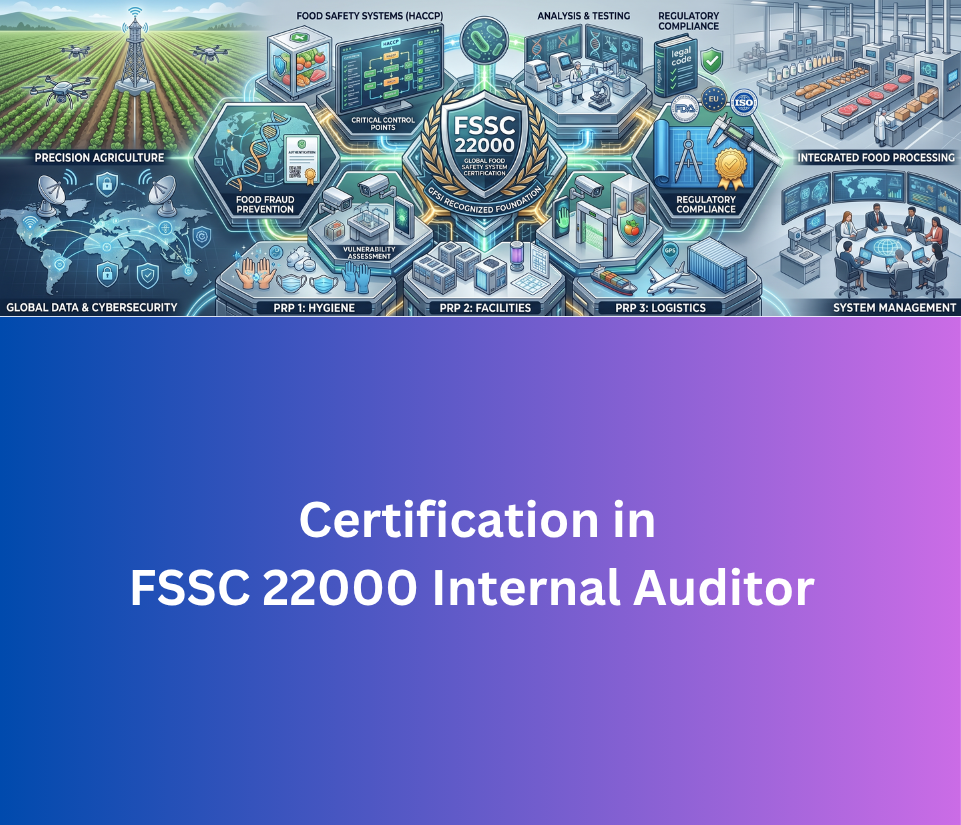
Purpose: The primary purpose of the FSSC 22000 Internal Auditor Course is to equip food safety professionals, quality assurance specialists, and operations managers with the competencies required to plan, conduct, report, and verify internal Food Safety Management System (FSMS) audits in accordance with FSSC 22000 Version 6 and ISO 19011:2018 standards. By mastering risk-based auditing methodologies, Hazard Analysis Critical Control Point (HACCP) validation, and statutory compliance frameworks, participants learn to identify process vulnerabilities, ensure continuous operational compliance, and drive organizational readiness for Global Food Safety Initiative (GFSI) benchmarked third-party certification.
Scope: The scope of this qualification covers the end-to-end audit lifecycle across the global food and beverage supply chain, integrating the full requirements of ISO 22000:2018, sector-specific Prerequisite Programs (PRPs such as ISO/TS 22002 series for food manufacturing, packaging, and catering), and mandatory FSSC 22000 Version 6 Additional Requirements. It encompasses audit scheduling, checklist preparation, on-site physical inspection, objective evidence gathering, non-conformity grading, root cause analysis, and corrective action validation across food processing, manufacturing, storage, distribution, and packaging operations.
Benefits of Qualification: Achieving certified internal auditor status validates technical competence in globally recognized food safety standards, significantly accelerating career growth in quality assurance, food safety compliance, operations management, and regulatory advisory roles. For food manufacturing and processing enterprises, having qualified in-house internal auditors strengthens food safety culture, minimizes contamination and product recall risks, ensures consistent adherence to national and international food safety regulations (such as FSSAI, FDA, and Codex Alimentarius), and optimizes operational efficiency through systematic defect elimination and audit readiness.
Responsibilities of Certified Personnel: Certified FSSC 22000 internal auditors are responsible for developing independent, risk-based internal audit schedules, reviewing food safety documentation, and auditing operational compliance against standard operating procedures, PRPs, and Critical Control Points (CCPs). Their core duties include conducting objective interviews, gathering verifiable audit evidence, categorizing non-conformities, evaluating root cause analyses submitted by auditees, monitoring the close-out of Corrective and Preventive Actions (CAPA), and reporting comprehensive audit findings to senior leadership during FSMS management review meetings.
Eligibility Criteria: This course is designed for food safety team leaders, QA/QC executives, production supervisors, regulatory compliance officers, food technologists, hygiene managers, and industry consultants. Applicants should hold a diploma, bachelor’s degree, or master’s degree in food science, food technology, microbiology, biotechnology, chemistry, agricultural sciences, life sciences, chemical engineering, or a related technical discipline. Prior basic familiarity with HACCP principles, ISO 22000 fundamentals, or practical experience within a food manufacturing, processing, packaging, or hospitality environment is recommended.
Assessment Procedure: Evaluation is conducted through continuous performance assessment and a formal final examination to verify theoretical knowledge and practical auditing skills. Continuous assessment evaluates active participation during simulated audit role-plays, mock document reviews, non-conformance report (NCR) drafting, and opening/closing meeting exercises. The final evaluation comprises a timed, objective and scenario-based written assessment covering standard interpretation, ISO 19011 audit techniques, and audit reporting. Candidates who attain a score of 70% or higher are awarded the verified FSSC 22000 Internal Auditor Certificate of Competence.
Curriculum: The structured curriculum covers the structural framework and updates of FSSC 22000 Version 6; interpretation of ISO 22000:2018 clauses (Context, Leadership, Planning, Support, Operations, Performance Evaluation, Improvement); implementation of sector-specific PRPs (ISO/TS 22002-1); FSSC Additional Requirements (Food Defense, Food Fraud Mitigation, Allergen Management, Environmental Monitoring, Food Safety Culture, and Equipment Design); ISO 19011:2018 auditing principles; risk-based audit planning and checklist development; opening and closing meeting management; objective evidence collection and interviewing techniques; non-conformity writing and grading; root cause analysis validation; and post-audit follow-up reporting.