
About iStudy

Getvarsity is established and incorporated with the objective to provide a comprehensive range of Continuous Professional Development (CPD), Personnel Skill Assessment, Industrial Quality standardization, Corporate Training, and Personnel Skill Certification solutions that meet the needs of stakeholders in an ever-changing Industrial ecosystem.

Account

Follow Us

ISO 22000 Internal Auditor Training Course - Food Safety Management Systems (FSMS)

Elevate your career and become a certified expert with our comprehensive ISO 22000 Internal Auditor Course. Designed to equip you with the essential skills to evaluate a Food Safety Management System (FSMS), this training provides an in-depth understanding of the ISO 22000:2018 standard requirements, High Level Structure (HLS), and advanced risk assessment. Through dynamic, tutor-led sessions and real-world examples, you will learn to confidently conduct internal audits, ensure industry compliance, and deliver professional audit reports following ISO 19011 guidelines. Master the tools needed to effectively mitigate risks and drive continuous improvement in your organization's food safety protocols.

Course Highlights

    • Duration: 2 Days / 16 Hours

    • Offline | Online | Hybrid | On - Job
    • Comprehensive ISO 22000:2018 Mastery: Gain an in-depth understanding of the latest Food Safety Management Systems (FSMS) standards and learn how to seamlessly apply the High-Level Structure (HLS) framework to your operations.

    • End-to-End Auditing & Reporting: Develop the practical expertise to confidently plan, execute, and evaluate internal audits. Learn to deliver clear, actionable reports in strict accordance with ISO 19011 guidelines.

    • Advanced Risk Assessment Techniques: Master the skills to proactively identify, evaluate, and mitigate food safety hazards, ensuring ongoing industry compliance and a secure supply chain.

    • Interactive, Expert-Led Learning: Step away from dry lectures and benefit from dynamic, tutor-led sessions featuring real-world case studies, practical exercises, and engaging peer interactions.

    • Career-Defining Certification: Step into a leadership role as a certified internal auditor, fully equipped to drive continuous improvement and uphold global food safety standards within your organization.

    • Upon completion of this course, you will be able to explain the process-based FSMS model for ISO 22000 in the context of the plan-do-check-act (PDCA) cycle, including the critical role internal audits play in maintaining and improving the system. Furthermore, you will understand the specific roles and responsibilities of an auditor in order to practically plan, conduct, report, and follow up on an internal FSMS audit in full accordance with ISO 19011 guidelines and ISO 22000 standards.
    • What is ISO 22000 : ISO 22000 is the internationally recognized standard for Food Safety Management Systems (FSMS). It provides a framework for organizations across the entire food supply chain—from "farm to fork"—to identify, control, and mitigate food safety hazards. By integrating principles like Hazard Analysis and Critical Control Points (HACCP) with standard management system protocols, ISO 22000 ensures that food is safe at the time of human consumption.
    • Purpose : The ISO 22000 Internal Auditor Training Course is designed to equip food safety professionals with the knowledge and practical skills required to conduct effective internal audits of an FSMS. The purpose is to empower your team to independently assess your organization's compliance with ISO 22000 standards, identify vulnerabilities in food safety protocols, and drive continuous improvement ahead of external certification audits.
    • Scope : This comprehensive training program covers the entire lifecycle of an internal audit in accordance with ISO 19011 (Guidelines for Auditing Management Systems) and the specific requirements of ISO 22000:2018. The scope of the course encompasses everything from understanding the core clauses of the standard to the practical aspects of audit planning, execution, and reporting. Participants will delve into hazard analysis, risk assessment methodologies, and the evaluation of critical control points, gaining a holistic view of how to safeguard the integrity of food products across diverse operational settings.
    • Benefits of Qualification : Achieving the ISO 22000 Internal Auditor qualification offers significant advantages for both individuals and their organizations. For professionals, it is a powerful catalyst for career advancement, positioning you as a specialized asset in quality assurance, compliance, and food safety management. For organizations, having an in-house certified auditor means drastically reducing the risk of product recalls, avoiding costly regulatory fines, and enhancing brand reputation. Furthermore, continuous internal auditing streamlines operational efficiency and builds unparalleled consumer trust by consistently delivering safe, high-quality food products.
    • Responsibilities of Certified Personnel : Once certified, an ISO 22000 Internal Auditor plays a critical role in safeguarding organizational compliance. Your core responsibilities will include designing comprehensive audit schedules, preparing checklists, and leading impartial internal audits. You will be tasked with gathering objective evidence through observation, interviews, and document reviews to assess FSMS conformity. Additionally, certified auditors are responsible for identifying non-conformities, issuing precise audit reports, and tracking Corrective and Preventive Actions (CAPA) to ensure that identified gaps are swiftly and permanently resolved.
    • Eligibility Criteria : This course is ideal for professionals currently working within the food sector who wish to deepen their auditing expertise. It is highly recommended for Food Safety Team Leaders, Quality Assurance and Quality Control (QA/QC) Managers, compliance officers, and food industry consultants. While there are no strict formal prerequisites to enroll, candidates will benefit greatly from a foundational understanding of basic food safety principles, HACCP concepts, and a general awareness of the ISO 22000 framework prior to attending.
    • Assessment Procedure : To ensure that all candidates possess the capability to conduct rigorous audits, the assessment procedure is both continuous and comprehensive. Participants are evaluated throughout the course based on their active participation in group exercises, role-playing scenarios, and practical mock audits. The training concludes with a final written examination designed to test both theoretical knowledge of the ISO 22000 standard and the practical application of auditing principles. Successful candidates who meet the passing criteria will be awarded the internationally recognized ISO 22000 Internal Auditor Certificate.
    • Curriculum : The ISO 22000:2018 Internal Auditor course curriculum provides a comprehensive deep dive into food safety management, beginning with a foundational overview of the standard and the High-Level Structure (HLS), emphasizing its importance in aligning various management systems. Students explore what’s new in the 2018 version, specifically focusing on the context of the organization, planning strategies, and the allocation of resources necessary for a robust system. The curriculum integrates core ISO 22000:2018 principles and requirements, spanning from operations and the introduction to HACCP to performance evaluation and improvements. A significant portion of the training is dedicated to the audit process and ISO 19011:2018 guidelines, covering audit terms, definitions, roles, and responsibilities, as well as the specifics of audit programs, reporting, and competency. Participants gain hands-on skills in performing an audit, managing documented information, identifying nonconformity and corrective action, and conducting Management Review Meetings (MRM) to ensure continuous compliance and food safety excellence.
    • IIRDC High Value Personnel Skill ⁠⁠Certification Issued by Section 8 Entity
    • Highly valued in the International job market with 150 + Countries Apostel Attestation Eligibility.
    • QR Scanning Verification to the Gov of India portal facility Available Upon Apostel Attestation.
    • Recognised in India, UAE, UK, USA, Canada, Australia, the Middle East and European markets
    • IIRDC is recognised through various international ISO Standard certifications by organizations who are responsible for assessing the competence and capability of organisations.

Placements & Internships

Sandra S
Arathy Manoj
Bineesh
Krishna Raj
Ahla M Jaseer
Muhammed Shijan K
muhammed Bin Yoonus
Anaga
Anagha D
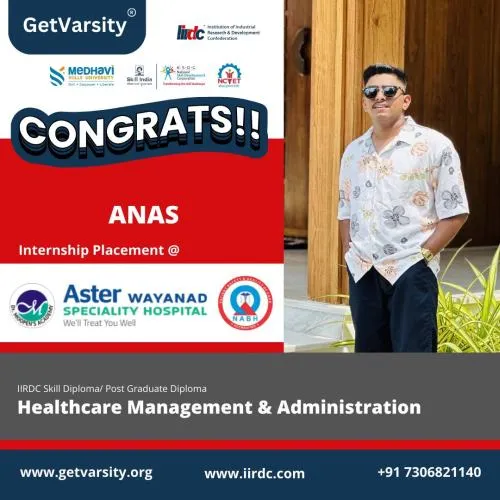
Anas

why getvarsity ?

skill india
Skill India Training Partner / Provider /
Project Management Unit (PMU)

IIRDC is an Skill India (Ministry of Skill Development &Entrepreneurship) TP which have rights to Approve, Accredit andCreate Training Centers (TC) under IIRDC and Impart NSQF, NHEQF,Non - NSQF Certification Programs. (Service Agreement Sl. No. B386880). All IIRDC TC’s would qualify as Government recognizedskill training institution status.

ncvet
NCVET Training Body

IIRDC is a Training Body having rights to Approve, Accredit and Create Training Centers under IIRDC TB of NCVET Awarding Body. Also IIRDC holds Rights of Research & Development of New Industry Anchored NSQFand NHEQF Qualifications Through AB. All confederation companiesunder IIRDC will be accredited skill centers of AB.

ugc
UGC Approved Skill University's Industry Outreach
Partner / Skill Training Partner & Service Partner

GetVarsity is a company, not a UGC-regulated HEI, and provides fee-based Skill training and institutional support, while universities handle all academic processes, including admissions, exams, and awarding degrees. GetVarsity partners with universities and industry to integrate higher education with skill development, supporting UGC-approved work-integrated, vocational, and apprenticeship-based programs aligned with NEP 2020. 

iirdc
Personnel Skill Assessment & Certification Body

IIRDC Is an Autonomus Skill Assessment and CertificationAwarding Bodyworking as per the norms under international standards forGeneralrequirements for bodies operating certification of persons.IIRDCensures that a certified candidate holds the skills andexpertise ina specialized area through systematic assessments.

TÜV SÜD
TUV SUD Germany Food Safety and Quality 1st Cooperation Partner in India

TÜV SÜD Germany is a globally trusted technical service providerwithover 150 years of legacy in quality assurance and safety.Renowned forits rigorous standards, TÜV SÜD offers comprehensive testing,inspection, auditing, and certification services tailored to the food industry. Getvarsity is an official Training center & Confederation company of IIRDC ( TÜV SÜD Cooperation Partner )

digilocker
DigiLocker Verified

All IIRDC NCrF (NHEQF / NSQF) Aligned Skill Qualification Certifications issued in association with NCVET AB will be added into DigiLocker — a platform where Government Documents like Aadhaar, PAN, and Driving License are issued and verified. Credits will also be issued in ABC verifiable through DigiLocker.

abc skill credits
Academic Bank of Credits (ABC) Body

ABC is a digital system established under the National Education Policy (NEP) to facilitate credit accumulation, transfer, and redemption across higher education institutions. It allows candidates to earn credits for completed coursework. As per the ABC framework, 30 hours of learning equate to 1 academic credit, ensuring standardized recognition of learning outcomes across institutions. All NCrF aligned courses provided by Getvarsity holds ABC Skill credits.
nad
National Academic Depository (NAD)

NAD is a platform established by the Government to securely store and verify academic awards issued. Managed by DigiLocker and integrated with the Academic Bank of Credits (ABC), it enables verified documents anytime, reducing fraud and administrative delays while supporting the goals of NEP 2020. Certificates issued for Getvarsity students, which are aligned to NCrF, is linked to NAD.

nep 2020
National Education Policy (NEP)

The National Education Policy (NEP) 2020 aims to create a flexible and integrated education system. It connects school, higher, and vocational learning through the National Credit Framework (NCrF), National Higher Education Qualification Framework (NHEQF), and National Skills Qualifications Framework (NSQF), enabling credit transfer, skill integration, and lifelong learning. Getvarsity delivers NCrF courses aligned to NEP 2020 

Frequently Asked Questions

The ISO 22000 Internal Auditor course is a specialized training program designed to teach professionals how to conduct internal audits of a Food Safety Management System (FSMS). The course covers the principles of the ISO 22000:2018 standard, auditing techniques, and how to identify compliance gaps. By the end of the training, you will have the skills to assess and improve your organization's food safety protocols to meet global standards.

This training is ideal for anyone involved in the food supply chain who is responsible for food safety. This includes food safety team leaders, quality assurance (QA) managers, compliance officers, hygiene managers, and existing internal auditors looking to upgrade their skills to the latest ISO 22000:2018 standard. It is also highly beneficial for consultants guiding organizations toward ISO 22000 certification.

While there are no strict mandatory prerequisites, we highly recommend that participants have a foundational understanding of food safety principles and the basics of Food Safety Management Systems (FSMS). Familiarity with Hazard Analysis and Critical Control Points (HACCP) and the general structure of ISO management standards will help you get the most out of this internal auditing course.

Earning your ISO 22000 Internal Auditor certification demonstrates to employers that you have the specialized skills required to maintain and improve food safety compliance. It makes you a critical asset to food manufacturing, processing, and packaging companies looking to pass external audits, avoid product recalls, and maintain consumer trust. This certification often leads to career advancement and increased earning potential in the quality and safety sectors.

Typically, our comprehensive ISO 22000 Internal Auditor course takes two to three days to complete. The training includes interactive workshops, case studies, and practical auditing exercises.

Yes! We offer a fully flexible, online ISO 22000 Internal Auditor course. Our virtual training provides the same high-quality instruction, real-world case studies, and interactive sessions as our in-person classes, allowing you to earn your FSMS auditor certification from anywhere in the world at your own pace.

Absolutely. Our curriculum is entirely up-to-date and heavily focused on the current ISO 22000:2018 standard. You will learn about the High-Level Structure (HLS), the risk-based thinking approach, and the integration of the PDCA (Plan-Do-Check-Act) cycle at both the organizational and operational levels.

While both are vital for food safety, they are distinct. HACCP (Hazard Analysis and Critical Control Points) is a risk management tool specifically focused on identifying and controlling food safety hazards. ISO 22000, on the other hand, is a comprehensive Food Safety Management System (FSMS). ISO 22000 actually integrates all the principles of HACCP but goes further by including broader organizational management protocols, interactive communication, and prerequisite programs (PRPs).

An Internal Auditor is trained to assess their own organization's FSMS (first-party audits) to ensure internal compliance and prepare the company for external certification. A Lead Auditor, however, undergoes more intensive training to perform external, third-party audits on behalf of certification bodies to grant official ISO 22000 certification to other companies. This course is specifically for those looking to master internal, first-party audits.

Yes. To successfully earn your ISO 22000 Internal Auditor certification, participants must pass a final assessment at the end of the training. This exam evaluates your understanding of the ISO 22000:2018 requirements, the auditing guidelines outlined in ISO 19011, and your practical ability to identify non-conformities during an audit.

Your ISO 22000 Internal Auditor certificate does not have a strict expiration date. However, it is tied to the current version of the standard. The active standard is ISO 22000:2018. If the International Organization for Standardization (ISO) releases a major revision or an entirely new version in the future, you will likely need to take a brief transition course to update your credentials and stay compliant.

Absolutely. If your organization is still operating under the older standard, having a trained internal auditor is the most efficient way to manage the transition. The course highlights the key differences introduced in the 2018 update, specifically the High-Level Structure (HLS) and the emphasis on risk-based thinking, allowing you to audit the gaps in your current system.

ISO 22000 is a broad, internationally recognized food safety management standard applicable to any organization in the food chain. FSSC 22000 is a certification scheme that includes the ISO 22000 standard, but adds specific sector prerequisite programs (PRPs) and additional FSSC requirements. FSSC 22000 is recognized by the Global Food Safety Initiative (GFSI), while standalone ISO 22000 is not. Understanding ISO 22000 through this auditor course is the foundational step for both.

A successful internal audit follows the guidelines of ISO 19011 and generally includes four main stages:

  1. Preparation and Planning: Creating an audit plan and reviewing FSMS documentation.

  2. Execution: Conducting on-site interviews, observing processes, and gathering objective evidence.

  3. Reporting: Documenting findings, identifying non-conformities, and writing the final audit report.

  4. Follow-up: Verifying that corrective actions have been properly implemented by management.

The ISO 22000:2018 standard requires organizations to conduct internal audits at "planned intervals." While the exact frequency is up to the organization based on the complexity and risk level of their food processes, industry best practice dictates that a full Food Safety Management System (FSMS) should be audited at least once a year. High-risk areas or processes with previous compliance issues should be audited more frequently.

Yes, absolutely! Because the ISO 22000:2018 update adopted the High-Level Structure (HLS)—the identical core framework used by other modern ISO standards—it is incredibly easy to integrate it with ISO 9001 (Quality) or ISO 14001 (Environmental). In this internal auditor training, you will learn how this unified structure allows you to perform streamlined, combined audits for an Integrated Management System (IMS), saving your company significant time and resources.

No, a formal degree in food science or microbiology is not a mandatory requirement to take the ISO 22000 Internal Auditor course. While a background in food manufacturing, catering, or agriculture is highly beneficial, the most important prerequisite is a working knowledge of general food safety principles, hygiene practices, and basic HACCP concepts.

A non-conformity occurs when a process, product, or system fails to meet a specific requirement outlined in the ISO 22000 standard or the company's own FSMS documentation. During this auditor training, you will learn how to identify, categorize (as major or minor non-conformities), and accurately document these issues so your management team can implement effective corrective actions.
Yes. Gathering evidence is only half the job; communicating your findings is just as critical. Our ISO 22000 Internal Auditor training includes comprehensive modules on how to draft clear, objective, and actionable audit reports. You will learn how to present your findings to top management in a way that drives continuous improvement in your food safety protocols.

Yes, understanding the distinction between standard Prerequisite Programs (PRPs), Operational PRPs (OPRPs), and Critical Control Points (CCPs) is a core component of ISO 22000. This training will teach you how to audit these specific hazard control measures to ensure they are properly validated, monitored, and verified according to the 2018 standard's strict requirements.

While this course deeply covers how to audit Hazard Analysis and Critical Control Points (HACCP) as part of the broader ISO 22000 standard, it is not a standalone HACCP certification course. However, because ISO 22000 integrates all HACCP principles, becoming an ISO 22000 internal auditor demonstrates a high-level mastery of HACCP concepts and risk assessment.
Adding this certification to your resume opens doors to several high-demand roles in the food and beverage industry. Common job titles for certified individuals include Food Safety Internal Auditor, Quality Assurance (QA) Manager, Food Safety Compliance Officer, Supply Chain Auditor, and FSMS Consultant. It is a highly sought-after credential for professionals looking to move into management or regulatory compliance.

Taking a Foundation course is not strictly mandatory, but it is highly recommended if you are entirely new to Food Safety Management Systems. If you already have working experience in the food industry, basic knowledge of the PDCA (Plan-Do-Check-Act) cycle, and an understanding of food safety hazards, you can step directly into the Internal Auditor course.

To prepare for an internal audit, an organization should first ensure all FSMS documentation (policies, HACCP plans, SOPs) is up-to-date and accessible. Next, communicate the audit schedule to your team so they know what to expect. Finally, encourage open communication; the goal of an internal audit is not to "catch" employees making mistakes, but to find system weaknesses and improve them before a formal external certification audit.

ISO 19011 is the international standard that sets the guidelines for auditing any management system. While ISO 22000 tells you what the food safety rules are, ISO 19011 tells you how to actually conduct the audit (how to plan, how to interview staff, how to collect evidence, and how to write the report). Our course combines the rules of ISO 22000 with the practical auditing techniques of ISO 19011.

Vision
Vision

To be a Global Benchmark in Multidisciplinary Innovations, Skill Excellence and Quality Standards.

Autonomous

IIRDC Accredited Confederation Member Organization. IIRDC Autonomous Professional body Incorporated and Established under section-8, Act 2013, formerly known as Section -25, Act 1956, Regulated by the Ministry of Corporate Affairs, Government of India

Mission
Mission

To deliver high-quality solutions through innovation, integrity, and collaboration while prioritising client satisfaction and sustainable development.

Accreditations | Association | Approvals | Certifications | Memberships

image
image
image
image
image
image
image
image
image
image
image
image
image

Why Choose IIRDC NCrF / IIRDC NHEQF Certification

India’s first and Kerala’s only IIRDC NHEQF Credit Certificate. Getvarsity is Officially Entitled to provide IIRDC NSQF, IIRDC NHEQF, IIRDC Personnel Skill Certification, etc., through IIRDC Accreditation as a confederation training partner.

The IIRDC NCrF/IIRDC NHEQF certificate will be recognised as a skill qualification in various sectors.

Valid for state/central government, Private sector jobs where skill qualifications are allowed under IIRDC NSQF/IIRDC NHEQF.

National Academic Depository (NAD) enabled program

NSDC, NCVET, UGC, Skill India, University, NCrF approved IIRDC NCrF Certification

Partnered with Skill India by the Ministry of Skill Development and Entrepreneurship

IIRDC NCrF/ IIRDC NHEQF Certificates Issued on DigiLocker: Secure, government-authenticated verification.

Credits issued on ABC (Academic Bank of Credits) in Digilocker (40 & 20 as per Hrs)

Embassy Attestation Eligibility

IIRDC NHEQF/ NSQF is fully aligned with NCrF (National Credit Framework)

Recognition across universities: Acceptable by HEIs (Higher Education Institutions) that follow UGC guidelines.

Courses are mapped with industry competency standards, increasing job readiness.

Aligns with NEP 2020 (National Education Policy) for multidisciplinary, flexible education.

Stackable learning: Can stack multiple level-based certificates towards a higher qualification.

Can be used for applying to government MSME schemes, subsidies, and loans (like Mudra, PMEGP) which ask for proof of technical training.

Helps learners get priority in Apprenticeship (NATS/NAPS) and Internship schemes under various ministries where skill qualifications are mandatory.

icon

Internship Placements in 2023-2024

icon

Industry Expert faculties & mentor network

icon

Entity Associated With NCVET Awarding Bodies

icon

In Certification & Training

icon

Industry Driven / Anchored Updated Curriculum

icon

One Who Introduced Internship Integrated Skill Development

icon

Skill University Industry Outreach Partner

icon

Loans & Financial Assistance For Eligible Learners

icon

Years Skill Development Track Record For Board Members

icon

Accredited Skill Training, & Certification Center

icon

Autonomous IIRDC Confederation Entity

icon

Attestations Eligibility

icon

IIIRDC Accredited Skill Centers in across India

icon

One among few IIRDC Confederation Companies

icon

Skill training centers in prime locations

icon

One who introduced Placement Assistance and Career development Module

icon

Certificates with International Online Verification through IIRDC or awarding body Website

icon

Offline | Online | Hybrid | On - Job Learning Modes

icon

implementation of courses adheres to National Educational Policy (NEP) 2020 in association with NCVET

icon

No Cost EMI Finance options

icon

MOU’s with multiple organizations

icon

Dedicated Research and Development wing

icon

Innovation and Entrepreneurial Support

icon

No.1 in curriculum and practicals

Call Back Request Form

Talk to us?

Call us?