
About iStudy

Getvarsity is established and incorporated with the objective to provide a comprehensive range of Continuous Professional Development (CPD), Personnel Skill Assessment, Industrial Quality standardization, Corporate Training, and Personnel Skill Certification solutions that meet the needs of stakeholders in an ever-changing Industrial ecosystem.

Account

Follow Us

Highfield Level 3 & Highfield Level 4 Award in HACCP for Food Manufacturing/ Catering (RQF & International) Certification & Training

Master the advanced science of hazard characterization, critical limit validation, and food safety governance with the Highfield Level 3 & Level 4 Award in HACCP for Food Manufacturing and Catering (RQF & International), a premier qualification engineered for HACCP Team Leaders, Quality Assurance Managers, Technical Directors, and Executive Chefs across industrial processing plants, commercial catering facilities, and central flight kitchens. Aligned directly with the Codex Alimentarius General Principles of Food Hygiene (CXC 1-1969, rev. 2020), GFSI-benchmarked standards (including BRCGS Issue 9 and FSSC 22000 v6), and international statutory mandates—such as the UK Food Safety Act, EU Regulation (EC) No 852/2004, US FDA FSMA (21 CFR Part 117), FSSAI regulations, and GCC municipal food codes—this progressive dual-level program delivers end-to-end technical mastery from operational supervision to executive food safety architecture. Gain comprehensive competency in executing the 5 preliminary steps and 7 Codex principles, applying logical decision trees to establish CCPs and oPRPs, validating thermal destruction kinetics ($D$-values and $z$-values), designing Environmental Monitoring Programs (EMP) targeting Listeria monocytogenes and Salmonella, and leading cross-functional HACCP teams. Earn an Ofqual-regulated RQF or Highfield International credential that satisfies mandatory BRCGS competency clauses, eliminates catastrophic contamination risks, prevents costly recalls, and accelerates senior quality and technical leadership careers across manufacturing and catering operations in the UK, the UAE, Saudi Arabia, India, the US, Canada, and Australia.


Course Highlights

    • Purpose: The primary purpose of the Highfield Level 3 and Level 4 Award in HACCP for Food Manufacturing and Catering (RQF & International) qualifications is to empower food safety professionals, quality assurance managers, production supervisors, and catering directors with the technical, scientific, and regulatory expertise required to design, implement, manage, validate, and verify robust Hazard Analysis and Critical Control Point (HACCP) systems. Aligned with the Codex Alimentarius General Principles of Food Hygiene (CXC 1-1969, rev. 2020), Global Food Safety Initiative (GFSI) benchmarked standards—including BRCGS Global Standard for Food Safety Issue 9, FSSC 22000 Version 6, and IFS Food—and international statutory frameworks such as the UK Food Safety Act, European Union Regulation (EC) No 852/2004, US FDA Food Safety Modernization Act (FSMA / 21 CFR Part 117), FSSAI regulations, and GCC municipal standards, these qualifications deliver a progressive pathway from operational supervision to executive food safety leadership. The Level 3 award equips practitioners to effectively implement and supervise HACCP plans within operational environments, whereas the Level 4 award delivers advanced scientific competence in hazard characterization, quantitative risk assessment, microbiological validation, and leading multidisciplinary HACCP teams to eliminate foodborne risks and uphold due diligence.
    • Scope: The operational scope of these dual qualifications spans the full spectrum of food manufacturing, industrial food processing, commercial catering, high-care cook-chill and cook-freeze operations, flight catering, institutional kitchens, cloud kitchens, and temperature-controlled logistics networks worldwide. It encompasses both the UK Regulated Qualifications Framework (RQF / Ofqual-regulated) pathways and Highfield International accredited standards, making the certification universally recognized across the United Kingdom, the European Union, the United Arab Emirates, Saudi Arabia, the wider GCC, India, the United States, Canada, and Australia. The scope systematically addresses the development and execution of prerequisite programs (PRPs), the 12 preliminary steps, and the 7 Codex principles across diverse production environments—ranging from thermal processing, canning, dry blending, and dairy pasteurization to complex sous-vide cookery, multi-course mass banqueting, and modified atmosphere packaging (MAP).

    • Benefits of Qualification: Earning an Ofqual-regulated RQF or Highfield International Level 3 or Level 4 Award in HACCP provides globally recognized validation of an individual’s food safety competence, unlocking career advancement into senior roles such as HACCP Team Leader, Quality Assurance Manager, Technical Director, Food Safety Auditor, Food Safety Consultant, and Head of Culinary Operations. For commercial food manufacturers and catering organizations, employing certified personnel directly satisfies the mandatory training and competence requirements of GFSI-benchmarked schemes (notably BRCGS Clause 2.1.1, which mandates that the HACCP team leader possess demonstrable competence in HACCP principles). Furthermore, certified personnel protect enterprises against catastrophic foodborne disease outbreaks, prevent severe regulatory enforcement penalties and factory closures, minimize commercial scrap and multi-million-dollar product recalls, and provide an unshakeable legal defense of due diligence during regulatory inspections and third-party audit verifications.
    • Responsibilities of Certified Personnel: Certified personnel bear the technical and managerial responsibility for the integrity, compliance, and ongoing governance of the organization’s food safety management system. Level 3 certified supervisors are responsible for overseeing the operational implementation of prerequisite programs (PRPs), auditing daily process controls, supervising line operators in CCP monitoring, verifying instrument calibration (such as digital thermometers and pH meters), initiating immediate corrective actions upon critical limit breaches, segregating affected batches, and maintaining contemporaneous audit-ready records. Level 4 certified practitioners are responsible for establishing and leading the multidisciplinary HACCP team, authoring comprehensive product descriptions and verified process flow diagrams, executing quantitative risk assessments, and determining Critical Control Points (CCPs) using validated decision trees. Moreover, Level 4 leaders are responsible for establishing and scientifically validating critical limits (using thermal death kinetics, $D$-values, $z$-values, water activity, and pH thresholds), establishing environmental monitoring programs (EMP) and microbiological verification protocols, directing root-cause investigations, orchestrating annual HACCP reviews, managing change control across new formulations and processing machinery, and defending the HACCP plan before statutory health authorities and certification auditors.
    • Eligibility Criteria: The eligibility criteria for these qualifications are structured hierarchically to match the pedagogical rigor and operational demands of each respective tier. Candidates applying for the Highfield Level 3 Award in HACCP should ideally possess an existing Level 2 or Level 3 Award in Food Safety, or hold a secondary school certificate alongside a minimum of one year of operational experience in food manufacturing, food service, or commercial catering operations where a basic understanding of food hazards and hygiene principles is established. Applicants seeking entry into the advanced Highfield Level 4 Award in HACCP must hold an existing Level 3 Award in HACCP or a Level 4 Award in Food Safety (or equivalent qualification), or hold a recognized bachelor’s or master’s degree in Food Science, Food Technology, Microbiology, Chemistry, Culinary Arts, Hospitality Management, or Environmental Health; alternatively, experienced quality managers, technical leads, and factory hygiene managers with at least two to three years of practical experience in managing or developing food safety management systems are eligible to enroll, provided they have proficient English communication skills to complete advanced technical analysis and written examinations.
    • Assessment Procedure: The assessment procedure for both qualifications utilizes rigorous, externally validated examination models that verify theoretical comprehension and applied practical competence under formal testing conditions. For the Highfield Level 3 Award, candidates complete an invigilated, closed-book examination comprising 45 to 60 objective multiple-choice questions (MCQs) mapped to scenario-based food safety challenges, with a pass mark typically set at 60% and a distinction awarded for scores of 80% or higher. For the Highfield Level 4 Award, candidates undergo an advanced, multi-part summative assessment comprising two rigorous written examination papers: Section 1 evaluates a comprehensive practical case study requiring candidates to critique, validate, and troubleshoot a complex food manufacturing or catering HACCP plan, while Section 2 comprises open-response, essay-style analytical questions addressing hazard characterization, critical limit justification, validation methodology, microbiological verification, and regulatory enforcement. Both sections of the Level 4 examination are externally set and marked by Highfield examiners, requiring candidates to achieve at least 60% in each section to pass, with merit and distinction classifications awarded for outstanding scientific precision and demonstrated managerial competence.
    • Curriculum: The curriculum provides comprehensive technical, scientific, and regulatory instruction spanning the entirety of food safety system design and verification across both Level 3 and Level 4 standards without reliance on fragmented instructional tiers. The course commences with advanced food safety governance, reviewing global food legislation, the Codex Alimentarius Commission, and the statutory obligations of food business operators under UK, EU, US FDA, FSSAI, and GCC legal frameworks. Learners explore the relationship between Prerequisite Programs (PRPs) and HACCP, examining hygienic plant design, zoning barriers (separating raw, low-risk, high-care, and high-risk environments), industrial CIP regimes, allergen management plans, water safety, and supplier approval programs. The coursework thoroughly details the 5 Preliminary Steps of Codex: assembling and leading the multidisciplinary HACCP team, constructing detailed product descriptions, defining intended consumer use (with special emphasis on vulnerable consumer groups), constructing linear process flow diagrams, and conducting rigorous on-site flow diagram verification across operating shifts. Candidates master the 7 Principles of HACCP: Principle 1 covers hazard identification and characterization across biological agents (pathogenic vegetative bacteria, spore-formers like Clostridium botulinum, viruses, parasites), chemical toxins (mycotoxins, pesticide residues, heavy metals), physical contaminants, allergens, and radiological hazards, followed by qualitative and quantitative risk ranking matrices. Principle 2 explores CCP determination methodologies, applying logical decision trees (such as Codex and Campden BRI trees) to differentiate between CCPs, Operational Prerequisite Programs (oPRPs), and standard PRPs. Principle 3 focuses on establishing measurable, scientifically validated critical limits, examining thermal lethality calculations ($D$-values, $z$-values, $F_0$ pasteurization and sterilization values), minimum core temperatures, chilling timelines, water activity ($a_w$), pH limits, and chemical concentrations. Principle 4 and Principle 5 detail real-time CCP monitoring protocols, continuous recording instrumentation, automated alert systems, immediate corrective action workflows, root-cause analysis (5 Whys and Fishbone), and the quarantine and disposition of non-conforming lots. Principle 6 delivers advanced training in validation, verification, and review, encompassing microbiological challenge testing, environmental pathogen monitoring (targeting Listeria monocytogenes and Salmonella), verification auditing, and triggers for HACCP plan re-validation (such as raw material substitutions, process modifications, or emerging hazards). The syllabus concludes with Principle 7, addressing documented information architecture, standard operating procedures (SOPs), calibration logs, digital HACCP record-keeping integrity, internal and third-party audit management, and the leadership dynamics required to cultivate a resilient corporate food safety culture.

Placements & Internships

Sandra S
Arathy Manoj
Bineesh
Krishna Raj
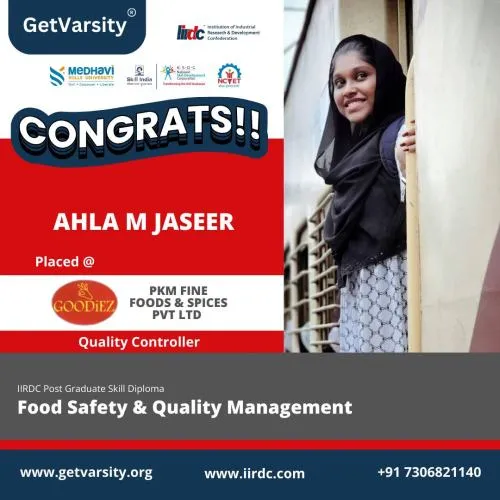
Ahla M Jaseer
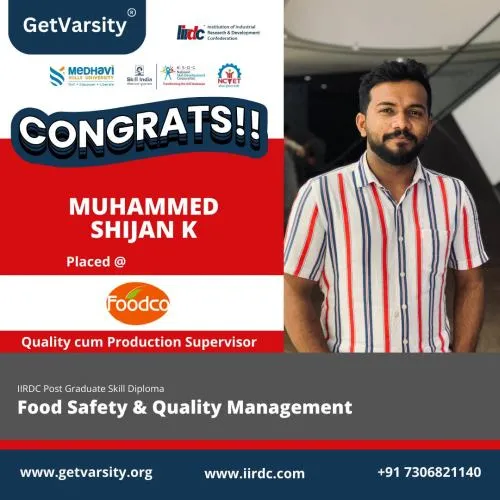
Muhammed Shijan K
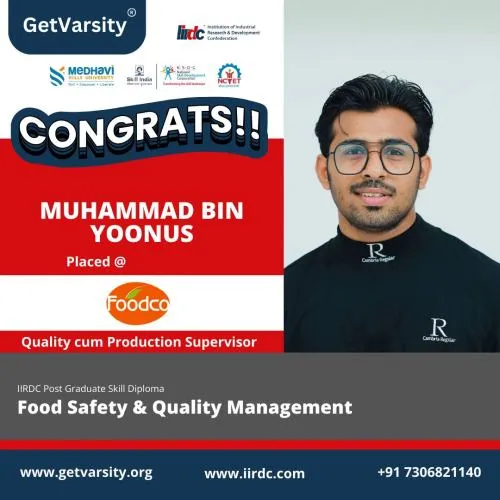
muhammed Bin Yoonus
Anaga
Anagha D
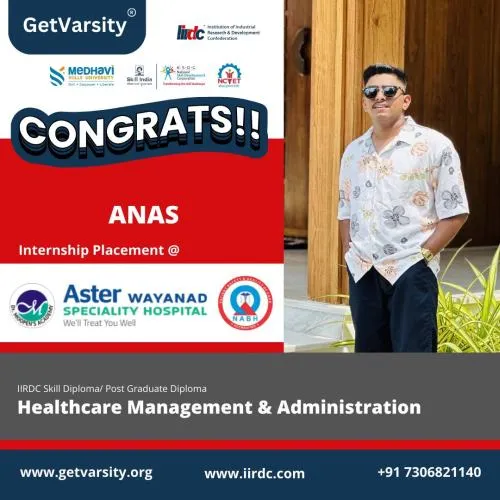
Anas

why getvarsity ?

skill india
Skill India Training Partner / Provider /
Project Management Unit (PMU)

IIRDC is an Skill India (Ministry of Skill Development &Entrepreneurship) TP which have rights to Approve, Accredit andCreate Training Centers (TC) under IIRDC and Impart NSQF, NHEQF,Non - NSQF Certification Programs. (Service Agreement Sl. No. B386880). All IIRDC TC’s would qualify as Government recognizedskill training institution status.

ncvet
NCVET Training Body

IIRDC is a Training Body having rights to Approve, Accredit and Create Training Centers under IIRDC TB of NCVET Awarding Body. Also IIRDC holds Rights of Research & Development of New Industry Anchored NSQFand NHEQF Qualifications Through AB. All confederation companiesunder IIRDC will be accredited skill centers of AB.

ugc
UGC Approved Skill University's Industry Outreach
Partner / Skill Training Partner & Service Partner

GetVarsity is a company, not a UGC-regulated HEI, and provides fee-based Skill training and institutional support, while universities handle all academic processes, including admissions, exams, and awarding degrees. GetVarsity partners with universities and industry to integrate higher education with skill development, supporting UGC-approved work-integrated, vocational, and apprenticeship-based programs aligned with NEP 2020. 

iirdc
Personnel Skill Assessment & Certification Body

IIRDC Is an Autonomus Skill Assessment and CertificationAwarding Bodyworking as per the norms under international standards forGeneralrequirements for bodies operating certification of persons.IIRDCensures that a certified candidate holds the skills andexpertise ina specialized area through systematic assessments.

TÜV SÜD
TUV SUD Germany Food Safety and Quality 1st Cooperation Partner in India

TÜV SÜD Germany is a globally trusted technical service providerwithover 150 years of legacy in quality assurance and safety.Renowned forits rigorous standards, TÜV SÜD offers comprehensive testing,inspection, auditing, and certification services tailored to the food industry. Getvarsity is an official Training center & Confederation company of IIRDC ( TÜV SÜD Cooperation Partner )

digilocker
DigiLocker Verified

All IIRDC NCrF (NHEQF / NSQF) Aligned Skill Qualification Certifications issued in association with NCVET AB will be added into DigiLocker — a platform where Government Documents like Aadhaar, PAN, and Driving License are issued and verified. Credits will also be issued in ABC verifiable through DigiLocker.

abc skill credits
Academic Bank of Credits (ABC) Body

ABC is a digital system established under the National Education Policy (NEP) to facilitate credit accumulation, transfer, and redemption across higher education institutions. It allows candidates to earn credits for completed coursework. As per the ABC framework, 30 hours of learning equate to 1 academic credit, ensuring standardized recognition of learning outcomes across institutions. All NCrF aligned courses provided by Getvarsity holds ABC Skill credits.

nad
National Academic Depository (NAD)

NAD is a platform established by the Government to securely store and verify academic awards issued. Managed by DigiLocker and integrated with the Academic Bank of Credits (ABC), it enables verified documents anytime, reducing fraud and administrative delays while supporting the goals of NEP 2020. Certificates issued for Getvarsity students, which are aligned to NCrF, is linked to NAD.

nep 2020
National Education Policy (NEP)

The National Education Policy (NEP) 2020 aims to create a flexible and integrated education system. It connects school, higher, and vocational learning through the National Credit Framework (NCrF), National Higher Education Qualification Framework (NHEQF), and National Skills Qualifications Framework (NSQF), enabling credit transfer, skill integration, and lifelong learning. Getvarsity delivers NCrF courses aligned to NEP 2020 

Highfield Qualifications International Approved Center

As a Highfield Qualifications International Approved Center, Getvarsity delivers globally recognized qualifications regulated by Ofqual and CCEA Regulation. Additionally, authorized to deliver programs in Wales, which are regulated by Qualifications Wales.

Frequently Asked Questions

Vision
Vision

To be a Global Benchmark in Multidisciplinary Innovations, Skills Excellence and Quality Standards.

Autonomous

IIRDC Accredited Confederation Member Organization. IIRDC Autonomous Professional body Incorporated and Established under section-8, Act 2013, formerly known as Section -25, Act 1956, Regulated by the Ministry of Corporate Affairs, Government of India

Mission
Mission

To deliver high-quality solutions through innovation, integrity, and collaboration while prioritising client satisfaction and sustainable development.

Accreditations | Association | Approvals | Certifications | Memberships

image
image
image
image
image
image
image
image
image
image
image
image
image
image

Why Choose IIRDC NCrF / IIRDC NHEQF Certification

India’s first and Kerala’s only IIRDC NHEQF Credit Certificate. Getvarsity is Officially Entitled to provide IIRDC NSQF, IIRDC NHEQF, IIRDC Personnel Skill Certification, etc., through IIRDC Accreditation as a confederation training partner.

The IIRDC NCrF/IIRDC NHEQF certificate will be recognised as a skill qualification in various sectors.

Valid for state/central government, Private sector jobs where skill qualifications are allowed under IIRDC NSQF/IIRDC NHEQF.

National Academic Depository (NAD) enabled program

NSDC, NCVET, UGC, Skill India, University, NCrF approved IIRDC NCrF Certification

Partnered with Skill India by the Ministry of Skill Development and Entrepreneurship

IIRDC NCrF/ IIRDC NHEQF Certificates Issued on DigiLocker: Secure, government-authenticated verification.

Credits issued on ABC (Academic Bank of Credits) in Digilocker (40 & 20 as per Hrs)

Embassy Attestation Eligibility

IIRDC NHEQF/ NSQF is fully aligned with NCrF (National Credit Framework)

Recognition across universities: Acceptable by HEIs (Higher Education Institutions) that follow UGC guidelines.

Courses are mapped with industry competency standards, increasing job readiness.

Aligns with NEP 2020 (National Education Policy) for multidisciplinary, flexible education.

Stackable learning: Can stack multiple level-based certificates towards a higher qualification.

Can be used for applying to government MSME schemes, subsidies, and loans (like Mudra, PMEGP) which ask for proof of technical training.

Helps learners get priority in Apprenticeship (NATS/NAPS) and Internship schemes under various ministries where skill qualifications are mandatory.

icon

Internship Placements in 2023-2024

icon

Industry Expert faculties & mentor network

icon

Entity Associated With NCVET Awarding Bodies

icon

In Certification & Training

icon

Industry Driven / Anchored Updated Curriculum

icon

One Who Introduced Internship Integrated Skill Development

icon

Skill University Industry Outreach Partner

icon

Loans & Financial Assistance For Eligible Learners

icon

Years Skill Development Track Record For Board Members

icon

Accredited Skill Training, & Certification Center

icon

Autonomous IIRDC Confederation Entity

icon

Attestations Eligibility

icon

IIIRDC Accredited Skill Centers in across India

icon

One among few IIRDC Confederation Companies

icon

Skill training centers in prime locations

icon

One who introduced Placement Assistance and Career development Module

icon

Certificates with International Online Verification through IIRDC or awarding body Website

icon

Offline | Online | Hybrid | On - Job Learning Modes

icon

implementation of courses adheres to National Educational Policy (NEP) 2020 in association with NCVET

icon

No Cost EMI Finance options

icon

MOU’s with multiple organizations

icon

Dedicated Research and Development wing

icon

Innovation and Entrepreneurial Support

icon

No.1 in curriculum and practicals

Call Back Request Form

Talk to us?

Call us?